






When Should You Get a Mole Checked? Warning Signs of Suspicious Skin Changes

Reviewed by
Dr. Monika Figueiredo
Specialist Dermatology
Get a mole checked promptly if it changes size, shape, or colour, has an irregular or blurred border, contains more than one colour, is wider than 6mm, or starts to itch, bleed, or crust. You should also book a routine mole check if you have many moles (50+), a family history of melanoma, fair skin, or significant sun exposure. Even without visible changes, a professional skin check once a year can help identify concerning changes early.
Most of us have moles somewhere on our body, and the vast majority are completely harmless. But moles can also be the earliest visible warning sign of melanoma, the most serious form of skin cancer, which is why knowing what to look for, and when to stop waiting and see a specialist, can genuinely save your life.
This guide walks through the warning signs dermatologists watch for, who should be extra cautious, and what a professional mole check at HealthBay actually involves.
Why Mole Checks Matter More Than You Think
Melanoma develops from the pigment-producing cells in the skin, and while it accounts for a smaller share of skin cancers than basal or squamous cell carcinoma, it is far more likely to spread if it isn’t caught early.
The encouraging part is that melanoma is highly treatable when detected at an early stage, which makes regular self-checks and timely professional evaluation one of the most effective forms of prevention available.
In a sun-intensive climate like the UAE, where UV exposure is strong for much of the year, this kind of vigilance matters even more, a point covered in more detail in our guide to protecting your skin in Dubai’s climate.
The ABCDE Rule: How to Spot a Suspicious Mole
A simple five-point checklist can help assess whether a mole needs closer attention. Run through it whenever you notice a new or changing spot
| Letter | Sign | What to Look For |
|---|---|---|
| A | Asymmetry | One half of the mole doesn’t match the other half in shape. |
| B | Border | Edges are irregular, notched, blurred, or poorly defined rather than smooth. |
| C | Colour | Uneven colouring, or a mix of brown, black, tan, red, white, or blue within one mole. |
| D | Diameter | Larger than 6mm (roughly the size of a pencil eraser), though melanomas can occasionally be smaller. |
| E | Evolving | Any change in size, shape, colour, elevation, or new symptoms like itching or bleeding over weeks to months. |
Other Warning Signs That Aren’t Part of the ABCDE Rule
Not every suspicious mole fits neatly into the ABCDE checklist. The following signs are also reasons to get a mole examined:
- A mole that itches, feels tender, or is painful to touch
- Bleeding, oozing, or crusting without any injury to the area
- A sore that doesn’t heal within a few weeks
- A new mole appearing after the age of 30, particularly if it looks different from your other moles
- The “ugly duckling” sign – a mole that looks noticeably different from all the others on your body
- A mole that becomes raised, scaly, or develops a firm lump within it
Is a New Mole a Reason to See a Dermatologist?
A new mole or new pigmented spot deserves attention, particularly when it appears later in adulthood or looks different from your other moles.
Most moles develop during childhood and young adulthood and remain relatively stable. A new or changing spot later in life should be assessed by a doctor rather than assumed to be harmless.
This does not mean that every new mole is cancerous. Many new skin growths are benign. The purpose of a professional assessment is to distinguish harmless lesions from those that may require monitoring or further investigation.
Who Should Be Extra Vigilant?
While anyone can develop skin cancer, some people carry a higher baseline risk and benefit from more frequent checks:
- Fair skin, light-coloured eyes, or hair that burns easily rather than tans
- More than 50 moles on the body, or several atypical (irregularly shaped) moles
- A personal or family history of melanoma or other skin cancers
- A history of severe or blistering sunburns, especially in childhood
- Regular outdoor work, sport, or sun exposure without consistent sun protection
- A weakened immune system, including from certain medications or medical conditions
If several of these apply to you, it’s worth discussing a personalised screening schedule with a skin specialist rather than waiting for a specific symptom to appear.
How Often Should You Get a Mole Check?
As a general guide, a professional skin check once a year is appropriate for the average adult, and every 6 to 12 months for anyone in a higher-risk category. Between visits, a monthly self-check – using a mirror or a partner’s help for hard-to-see areas like the back and scalp – makes it far easier to notice new changes early.
How to Check Your Moles at Home
A monthly skin self-check can help you become familiar with your normal pattern of moles and skin marks.
Follow these steps:
1. Check your skin in good lighting
Stand in front of a full-length mirror in a well-lit room.
2. Examine your entire body
Do not focus only on areas that receive sunlight. Check your face, neck, chest, abdomen, arms and legs.
3. Check difficult-to-see areas
Use a handheld mirror to examine your back, scalp and the backs of your legs.
4. Check your hands and feet
Look at your palms, fingers, soles of your feet and between your toes.
5. Check your nails
Look for unusual dark marks or bands under or around your fingernails and toenails.
6. Ask for help when needed
A partner, family member or friend can help you check areas such as your scalp and back that are difficult to see yourself.
7. Look for change
Pay particular attention to new spots or existing moles that have changed in size, shape, colour or texture.
Keeping photographs of unusual moles can sometimes help you notice changes over time, although photographs should not replace professional evaluation.
What Happens During a Professional Mole Check
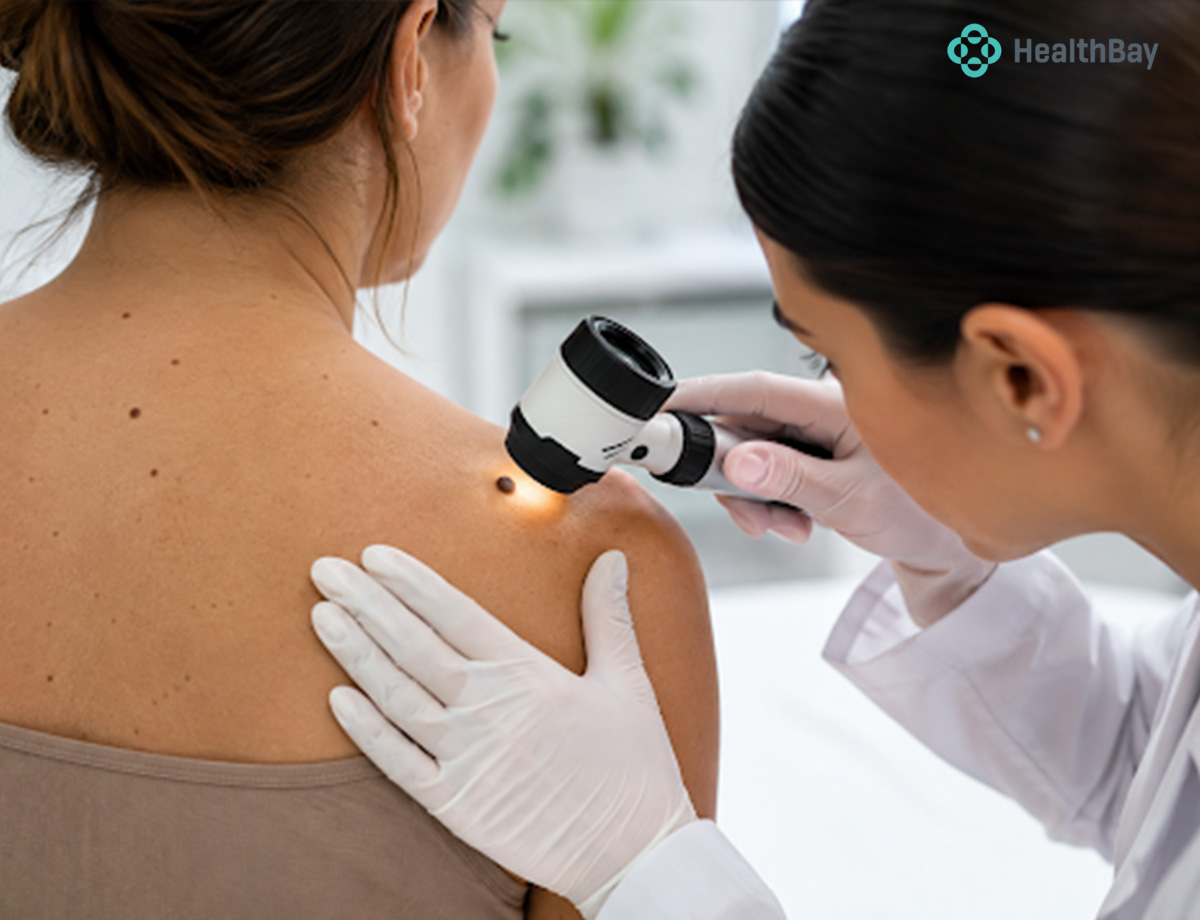
A professional evaluation is quick, non-invasive, and painless. At HealthBay, digital dermoscopy and mole mapping are used to photograph and document moles in high resolution, making it easier to track subtle changes over time and reducing unnecessary biopsies. The process usually includes:
- A full-body visual examination
- Close inspection of any concerning mole using a dermatoscope
- High-resolution photographic mapping for future comparison
- Biopsy referral only if a mole appears genuinely suspicious
When to See a Dermatologist Urgently
Most mole changes are not an emergency, but a few signs warrant a prompt appointment rather than a wait-and-watch approach:
- Rapid change in size, shape, or colour over just a few weeks
- Spontaneous bleeding or an open sore that won’t heal
- A new dark spot appearing suddenly in someone over 50
- A mole that stands out clearly from every other mole on your body
Can Skin Cancer Occur on Areas That Are Not Exposed to the Sun?
Yes.
Although many skin cancers occur in sun-exposed areas, melanoma can also develop in less obvious locations.
Pay attention to unusual changes on:
- The scalp
- Palms
- Soles
- Between the toes
- Fingernails
- Toenails
- Around the nails
Rare forms of melanoma can also occur in areas such as the eye or mucosal tissues. Any unusual or persistent pigmented change should be discussed with an appropriate healthcare professional.
Does Every Changing Mole Mean Cancer?
No.
Moles can change for several reasons, and many skin changes are not cancerous. However, it can be difficult to distinguish a harmless mole from melanoma or another skin condition based on appearance alone.
That is why a new or changing mole should not automatically be diagnosed at home.
FAQs
Yes , most adults have between 10 and 40 moles that remain stable for life. Stability is reassuring; it’s a new change that matters most.
Occasionally, yes. This is why any mole that looks or behaves differently from the rest , the “ugly duckling” ,should still be checked, even if it technically passes the ABCDE criteria.
No. Digital mole mapping is completely non-invasive – it uses photography and dermoscopy, with no needles or incisions involved.
Melanoma is rare in children, but any rapidly changing or unusual mole in a child should still be reviewed by a specialist. HealthBay’s medical team is experienced in paediatric skin conditions.
Yes – a skin and mole review can be included alongside a broader executive health checkup, making it easy to stay on top of your skin health without a separate visit.
Don’t Ignore Changes in Your Moles
Most moles are harmless, but noticing changes early can make a significant difference in detecting melanoma and other skin cancers at an early, more treatable stage. Pay attention to changes in size, shape, colour, borders, or symptoms such as itching, bleeding, crusting, or tenderness.
If a mole looks different from your others or you have a higher risk of skin cancer, a professional skin assessment can provide reassurance and timely medical advice.
If you have noticed a suspicious or changing mole, don’t wait for it to become more concerning.
Book a mole check with HealthBay’s dermatology team in Dubai for a professional skin examination and personalised guidance.
Book an Appoinment


